
Crop Production


Spotted wing drosophila (SWD), also called vinegar fly, came to the United States from China and established in the country (figure 1a). The insect is established in Alabama and currently can be found in all sixty-seven counties. It causes damage to small fruits like blueberries, strawberries, elderberry, blackberry, raspberries, and other wild berries. It can also attack crops like grapes and peaches. The adult female has a saw-like organ or structure, called an ovipositor, that it uses to cut through the soft skin of the fruit or berry to lay its eggs in the mature berries (figure 1b). As the young larva develops, it feeds on the fruit and causes the fruit to rot (figure 2).
Effective management of SWD requires that it be monitored throughout the growing season to determine population levels. As a result, Alabama Cooperative Extension System professionals initiated a trapping program at several locations in central Alabama (Clanton area) and north Alabama (Huntsville area) to monitor the insect and provide information on insect numbers. The trapping program began early in the season because SWD is an early season pest.
-
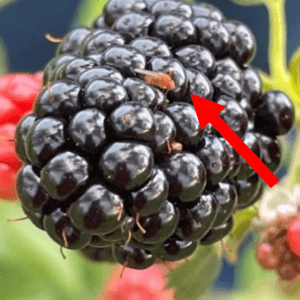
- Figure 1a. Adult SWD on a blackberry. Photo credit: Hannah Burrack, North Carolina State University, Bugwood.org
-
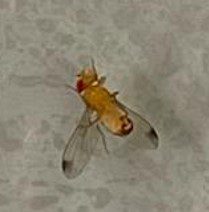
- Figure 1b. Male SWD. Note the two spots on the wings. Photo credit: Hannah Burrack, North Carolina State University, Bugwood.org
-

- Figure 1c. The saw-like ovipositor of an adult female SWD. Photo credit: Hannah Burrack, North Carolina State University, Bugwood.org
-
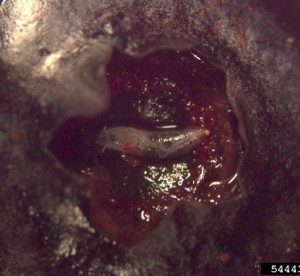
- Figure 2. Developing SWD larva on a blueberry. Photo credit: Frank A. Hale, University of Tennessee, Bugwood.org.
-
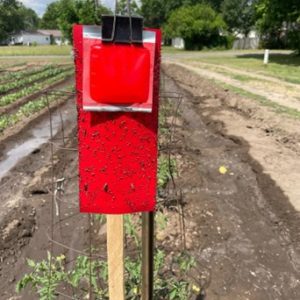
- Figure 3. Trécé Pherocon broad spectrum attractant installed together with red double sticky traps purchased from Trece Inc. in Adair, Oklahoma.
Traps
SWD traps were installed in the field in Huntsville March 1 and in Clanton March 14. The traps consisted of Trécé Pherocon broad spectrum attractant installed together with red double sticky traps (figure 3). In Clanton, four traps each were set up in four locations: wooded area, strawberry field, peach orchard, and fig orchard. In Huntsville, the SWD traps were set up March 1 in woods and a community garden located on the Alabama A&M University campus. Traps were checked every two weeks and numbers are provided in tables 1 and 2. Numbers are expected to increase, so growers are advised to keep their eye on berries that are ready and yet to be harvested.
Table 1. Mean Total Number of SWD Males and Females Captured in Clanton Traps
| Peach | Wood | Strawberry | Fig | Total | |
|---|---|---|---|---|---|
| March 21 | 120 | 520 | 62 | 156 | 858 |
| April 18 | 386 | 576 | 383 | 450 | 1795 |
| Total | 506 | 1069 | 445 | 606 | 2653 |
Table 2. Mean Total Number of SWD Males and Females Captured in Huntsville Traps
| Community Garden | Woods | Total | |
|---|---|---|---|
| March 15 | 13 | 126 | 139 |
| April 15 | 48 | 246 | 294 |
| April 30 | 66 | 383 | 449 |
| May 15 | 381 | 806 | 1187 |
| May 30 | 242 | 1026 | 1268 |
| Total | 750 | 2587 | 3337 |
Management
One way to control the insect is to harvest your crop early before the berries become too soft for the insect to lay its eggs. This will prevent the berries and fruit from getting too ripened, which will allow the insect to deposit its egg in the soft fruit.
To determine if larvae are present in berries, a salt floatation test can be used. To do this, harvest about 20 to 50 ripped berries and conduct salt test for the larvae. Dissolve 10 grams of salt in 500 milliliters of water. Place the berries in the salt solution in a container. You may want to mash the fruits or leave them intact. Watch the solution with the berries for 10 to 15 minutes. If larvae are present, they will float on the salt solution. It must be noted that it is difficult to differentiate other drosophila larvae from SWD larvae, so it is important to always use berries that are just ripening and not overripe berries.
More Information
Spotted wing drosophila remains a concern for gardeners and small fruit producers. However, with careful monitoring and timely management, this insect pest can be managed. For further information, contact Clement Akotsen-Mensah at 256-924-0457, Edgar Vinson at 334-728-2407, or your county Extension office.
Featured photo credit: Hannah Burrack, North Carolina State University, Bugwood.org