
Forestry

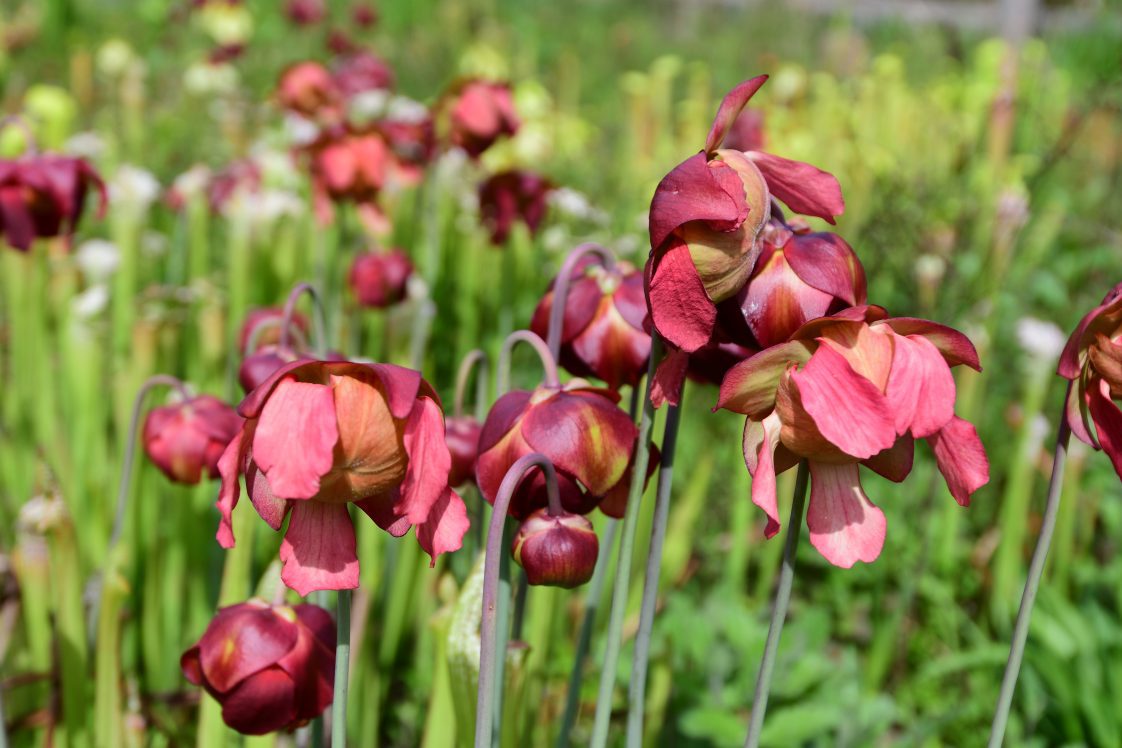
Pitcher plants are found throughout Alabama. Learn fun facts about these carnivorous plants growing in wetland areas including bogs.
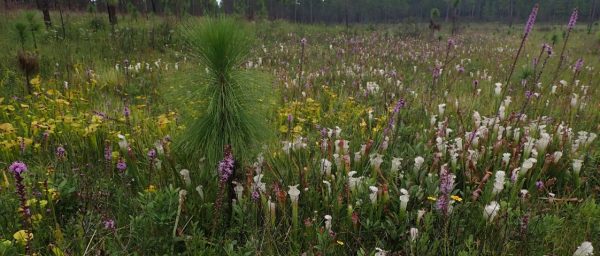
Figure 1. Yellow- and White-Topped Pitcher Plants in a Conecuh National Forest bog among longleaf pines.
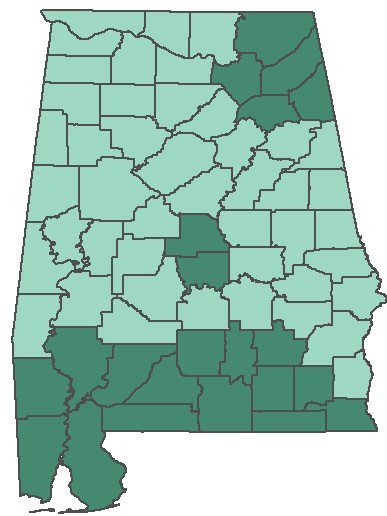
Figure 2. The pitcher plant species that occur in north and central Alabama are endangered species. All the species in southern counties are rare and depend on healthy habitats. Pitcher plants are present in the shaded counties.
Alabama is home to four genera of carnivorous plants: bladderworts (Utricularia), butterworts (Pinguicula), pitcher plants (Sarracenia), and sundews (Drosera). Carnivorous plants capture insects and other small animals to get necessary nutrients. They do this using various techniques such as sticky traps, bladder traps, and pitfall traps, giving them an advantage in the low-nutrient wetlands they inhabit.
Pitcher plants have the largest and showiest traps of all native carnivorous plants. They are most common in southern Alabama counties but also occur in bogs in northern and central parts of the state.
- North Alabama: Mountain Green Pitcher Plant, Sarracenia oreophila
- Central Alabama: Alabama Canebrake Pitcher Plant, S. alabamensis
- South Alabama: Burk’s Pitcher Plant, S. rosea; Parrot-Beaked Pitcher Plant, S. psittacina; Wherry’s Pitcher Plant, S. alabamensis subsp. wherryi; White-Topped Pitcher Plant, S. leucophylla; Winged Pitcher Plant, S. alata; Yellow Pitcher Plant, S. flava
Habitat
Pitcher plants grow in a variety of wetland areas such as bogs, meadows, hillside seeps, stream banks, and even roadside ditches. All of these are wet most of the year and typically have significant subsoil water flow. Grasses and forbs are the dominant plants in these areas. Pitcher plant habitat is most commonly referred to as a pitcher plant bog. Pitcher plant bogs are one of the most biodiverse habitats in the temperate world.
Physical Description
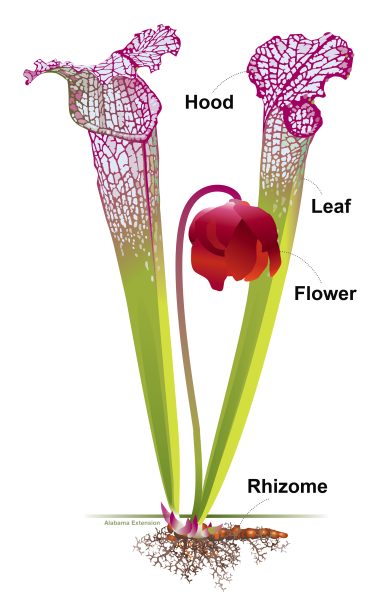
Figure 3. The hood is the part of the leaf that keeps rainwater from flushing prey out of each pitcher’s mouth.
The parts of the pitcher plant are rhizomes with roots, carnivorous leaves, and flowers. Most species are easily recognized by their large vertical open-mouthed pitchers that can be as much as 3 feet tall.
The pitchers are photosynthetic modified leaves that capture and digest prey. They exhibit two types of presentations— horizontal and vertical.
Burk’s and Parrot Pitcher Plants grow horizontal pitchers that can be slightly raised or flat on the ground. They arise from short vertical rhizomes in a radial pattern.
All other native pitcher plant species have vertically oriented leaves arising from horizontal rhizomes.
One common name for pitcher plants is dumbwatches. This name comes from their unusual-looking flowers that have a distinctive umbrella-shaped style said to resemble a clock with no hands. The flower’s petals are usually red, yellow, or sometimes pink and bloom in the spring. These later develop into 5-chamber fruit that can have more than a hundred seeds.
Leaves and flowers arise from the tip of a rhizome that can live for decades. The sturdy roots are tolerant of both flood and fire. Fleshy roots are important for anchoring the plant and absorbing water and micronutrients.
-
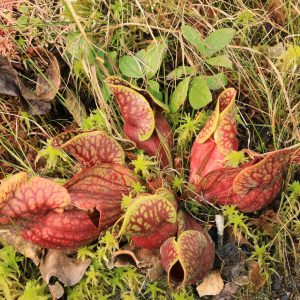
- Figure 4. Burk’s Pitcher Plant pitchers grow horizontally from their centers. (Photo credit: Noah Yawn)
-
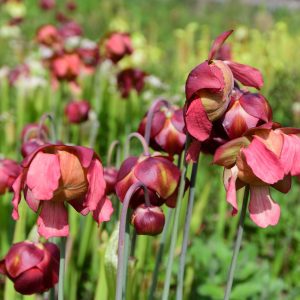
- Figure 5. White-Topped Pitcher Plants have red umbrella-shaped flowers.
-
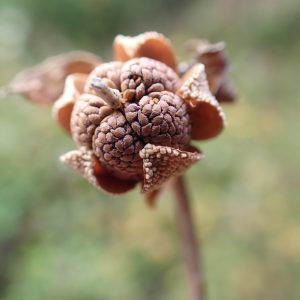
- Figure 6. Many seeds are visible on the fruit of this Alabama Canebrake Pitcher Plant capsule.
Threats
- Habitat loss. More than 98 percent of pitcher plant habitat has been destroyed due to infrastructure development, agricultural lands, and habitat alteration (for example, water flow).
- Fire suppression. Trees such as sweetgums, water oaks, and popcorn trees shade out the natural diversity of pitcher plant bogs. Fire is a natural part of this habitat, and if not suppressed, will prevent these trees from becoming established.
- Invasive species. Non-native invasive species take over habitats and displace native species, including pitcher plants.
- Wild collection. Both legal collection and poaching of pitcher plants in the wild have eliminated populations in various counties across the state.
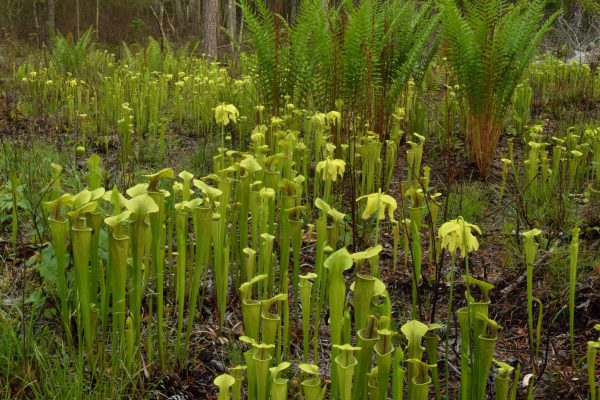
Figure 7. Mountain Green Pitcher Plants benefit from the fire-maintained bog conditions at a site in DeKalb County. (Photo credit: Noah Yawn)
Management
Properly managing for pitcher plant species benefits a wide variety of natural resources. Maintaining healthy hydrology is a key need for these plants, associated species, and ecosystem health. Pitcher plants require complex natural interactions to thrive.
Pitcher plants are very sensitive to habitat alterations and common land management practices such as herbicide applications and heavy equipment use. Conservation mowing can be used to maintain large open areas. In small areas where fire is not an option, mechanical management and removal of encroaching woodies using hand tools is recommended due to the high sensitivity of the areas.
Prescribed fire is the complex tool needed to meet the complex needs of these plants. When applied at the landscape level, the results are beneficial to not only the pitcher plants but also other species and ecological processes and services. For example, the Splinter Hill Bog Complex in Baldwin County is among the largest carnivorous plant communities in the world largely because of the use of fire management in the area.
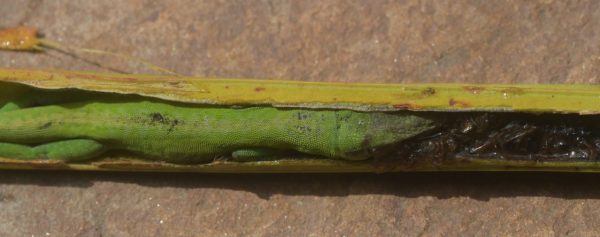
Figure 8. Even vertebrates occasionally fall prey to the meat-eating plants of Alabama, as shown here by a green anole trapped in a White-Topped Pitcher Plant.
Superlatives
- Alabama has more species of Sarracenia pitcher plants than anywhere else in the world.
- Alabama’s pitcher plants are the tallest standing carnivorous plant in the world, reaching 3 to 4 feet tall.
- Alabama is home to two federally endangered pitcher plants—the Alabama Canebrake Pitcher Plant and the Mountain Green Pitcher Plant.
- All Alabama native pitcher plant species, except for the Mountain Green Pitcher Plant, are associated with the longleaf pine plant community.
 Emily Nichols, Extension Specialist, and Patrick Thompson, Curator, Davis Arboretum, both with Auburn University
Revised July 2025, Meet Alabama’s Meat-Eating Pitcher Plants, FOR-2181