
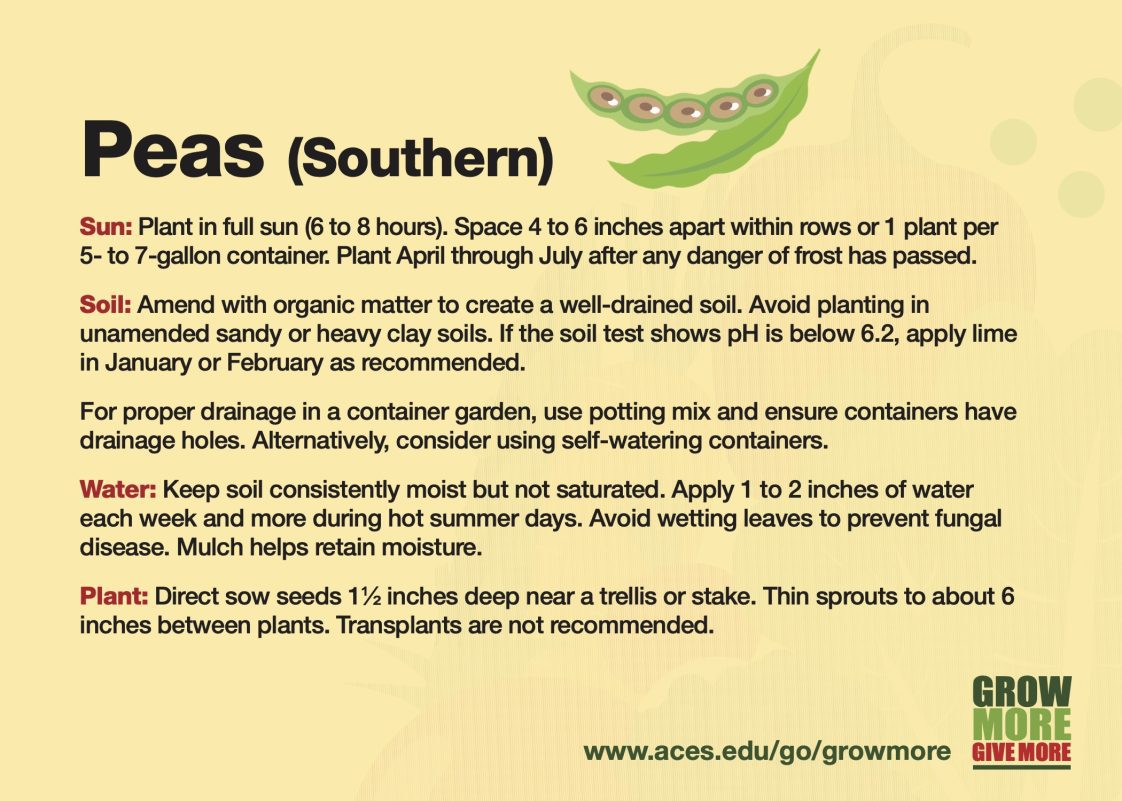
Sun: Plant in full sun (6 to 8 hours). Space 4 to 6 inches apart within rows or 1 plant per 5- to 7-gallon container. Plant April through July after any danger of frost has passed.
Soil: Amend with organic matter to create a well-drained soil. Avoid planting in unamended sandy or heavy clay soils. If the soil test shows pH is below 6.2, apply lime in January or February as recommended.
For proper drainage in a container garden, use potting mix and ensure containers have drainage holes. Alternatively, consider using self-watering containers.
Water: Keep soil consistently moist but not saturated. Apply 1 to 2 inches of water each week and more during hot summer days. Avoid wetting leaves to prevent fungal disease. Mulch helps retain moisture.
Plant: Direct sow seeds 11⁄2 inches deep near a trellis or stake. Thin sprouts to about 6 inches between plants. Transplants are not recommended.
Fertilize: In the absence of a soil test, apply an all-purpose fertilizer (8-8-8 or 10-10-10) at planting. Use one-half the recommended rate of nitrogen; too much nitrogen will stop flower and pod production.
Insects/Diseases/Weeds: Scout plants frequently for insect/disease damage. Use insecticidal soap (for soft-bodied insects) or Bt dust or spray (for caterpillars, or worms). Spray fungicide regularly to suppress common fungal diseases. Always follow label instructions. Mulch inhibits weeds and diseases.
Harvest: Harvest at 60 to 70 days, when pods are fully developed. Harvest time varies depending on the variety.
Other: Maintain uniform soil moisture during bloom and pod development.
Visit www.aces.edu/go/growmore for more information.
Learn how to grow the best fruits and vegetables with the Grow More Garden Series at www.aces.edu/go/growmore.
Bethany O’Rear, Extension Agent, Home Horticulture, Auburn University
Revised December 2023, Grow More Peas (Southern), ANR-2876-N
Download This Article as a PDF
- Grow More Peas (Southern) (English), ANR-2876-N
- Grow More Peas (Southern) (Chinese), ANR-2876-N
- Grow More Peas (Southern) (Korean), ANR-2876-N
- Grow More Peas (Southern) (Spanish), ANR-2876-N