
​Safe Grilling of Veggies
FWNRM Team Releases Wild Pig Management Videos
Timely Travel Tips for Diabetics on Vacation
Trees, Trucks, & Power Lines
E-health, Health Literacy and You
Children and Money
Weed'em & Reap Workshops

A County Older than the State
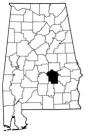
Montgomery County has a very colorful background. Settlers first began to populate the area in the early 1800s. The County of Montgomery was created by an Act of the Legislature of the Mississippi Territory on December 6, 1816, one year before Congress passed the enabling act, allowing the creation of the Alabama Territory from the Mississippi Territory. Montgomery County was carved out of Monroe County and originally embraced the majority of central Alabama, east of the ridge dividing the Tuscaloosa and Tombigbee Rivers from the Cahaba River, west of the Okfuskee and Coosa, and south of the mountains of Blount. However, it was soon subdivided and portions were set apart which made up Elmore, Bullock, and Crenshaw counties.
Montgomery County was named in memory of Major Lemuel P. Montgomery of Virginia, who fell at the Battle of Horseshoe Bend on March 27, 1814, becoming the first man to die in the battle. A statue in honor of Major Montgomery graces the entrance of the Montgomery County Courthouse, located at 251 S. Lawrence Street.
The lands of Montgomery County were put up for auction at the Federal Land Office in Milledgeville, Georgia in 1816. Larger parcels were sold to developers who subdivided the land into lots for urban commercial and residential use, predetermining a major city on the banks of the Alabama River at Montgomery.
When the Alabama Lands were offered for sale in 1817, two groups of speculators made their initial payments. One group, a company of Georgians led by General John Scott, bought the area along the river bluff and called it "Alabama Town." Later, a second group, led by Andrew Dexter, bought the area bounded by present day Court, Ripley, Scott, and Jefferson Streets and named it "New Philadelphia." The Georgians abandoned the Alabama Town and built the town of East Alabama, in competition.
A bitter rivalry between the two groups was finally terminated when the two towns were merged under the name Montgomery and incorporated December 3, 1819, eleven days before the State of Alabama was admitted into the Union.
The City of Montgomery, which became the county seat in 1822, was built on the side of the Indian town Ikanatchati (Econachatee), which means red ground, and Towasa on a high red bluff known to Alibamu Indians as Chunnaanaauga Chatty. Hernando DeSoto and his troops, who passed near Montgomery in the autumn of 1540, were the first Europeans to visit this region.
The City of Montgomery remained the sole municipality in the county until the Town of Pike Road incorporated in 1997.
Today, Montgomery County has an estimated population of over 223,000, making it the fourth largest county in the State.
The population is 94 percent urban, 6 percent rural, 56 percent white and 44 percent black. There are 56 educational outlets in the county.
Montgomery County is called the "cattle capital of the South" and ranks sixth in the state for all cattle produced. Montgomery has about 40,000 head. The county's agricultural income is about $50 million with 650-plus farms. The average farm size is 368 acres. Beef cattle, catfish, broilers, eggs and hay are the major agricultural crops.
Tourist attractions in the county include:
-
Alabama Shakespeare Festival, Rosa Parks Library/Museum and Children’s Wing, Martin Luther King Home, Civil Rights Memorial, Dexter Avenue King Memorial Baptist Church, Montgomery Museum of Fine Arts, Civil Rights Memorial Center, Alabama State Capitol, White House of the Confederacy, Montgomery Visitors Center, Freedom Rides Museum, F. Scott and Zelda Fitzgerald Museum, Wynton M. Blount Cultural Park, Montgomery Zoo, Alabama Department of Archives and History, Montgomery Ballet, The Davis Theatre, Confederate Monument, Hank Williams Memorial – Oakwood Annex Cemetery, Huntingdon College, Riverfront Park, Old Alabama Town, Court Square, Hank Williams Museum, St. John’s Episcopal Church, Montgomery City Planetarium, Greenwood Cemetery, Creek Casino Montgomery, Governor’s Mansion, The MOOseum, Rosa Parks Arrest Site, Court Square Fountain, Montgomery Performing Arts Center, Biscuits Baseball, Hyundai Motor Manufacturing Plant Tour
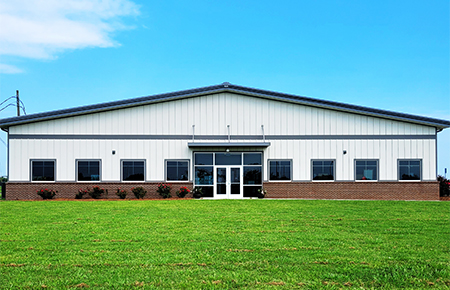
The Montgomery County Extension Office has 13 full-time employees. Current active Extension programs include Master Gardener Program, Monthly Beef Programs, Urban Programs, UNEP, EFNEP and 4-H.


